SMS Marketing by Vertical
SMS Marketing for Insurance Agents: From New Lead to Renewal
SMS Marketing for Insurance Agents: From New Lead to Renewal
An insurance lead is rarely yours alone. The same quote request is often sold to several agents, and the first one to respond wins 78% of the time. Call that lead from an unknown number and the odds are against you: only 19% of people pick up.
SMS marketing for insurance agents fixes the first touch and then keeps working through the whole policy lifecycle: quote, bind, service, renewal, and cross-sell. This playbook covers all seven stages, with templates, compliance basics, and the numbers to track.
What Is SMS Marketing for Insurance Agents?
It is using text messages to start, continue, and close conversations with insurance prospects and policyholders. Done well, it is not blasting promotions. It is a two-way channel: you respond to a quote request in seconds, answer questions, book the call, and stay in touch through renewal.
Why Texting Wins for Insurance
- Speed decides shared leads. When five agents get the same lead, the one who starts the conversation first usually writes the policy. Our speed to lead guide explains the math.
- People do not answer unknown calls. Only 19% pick up. A text gets read.
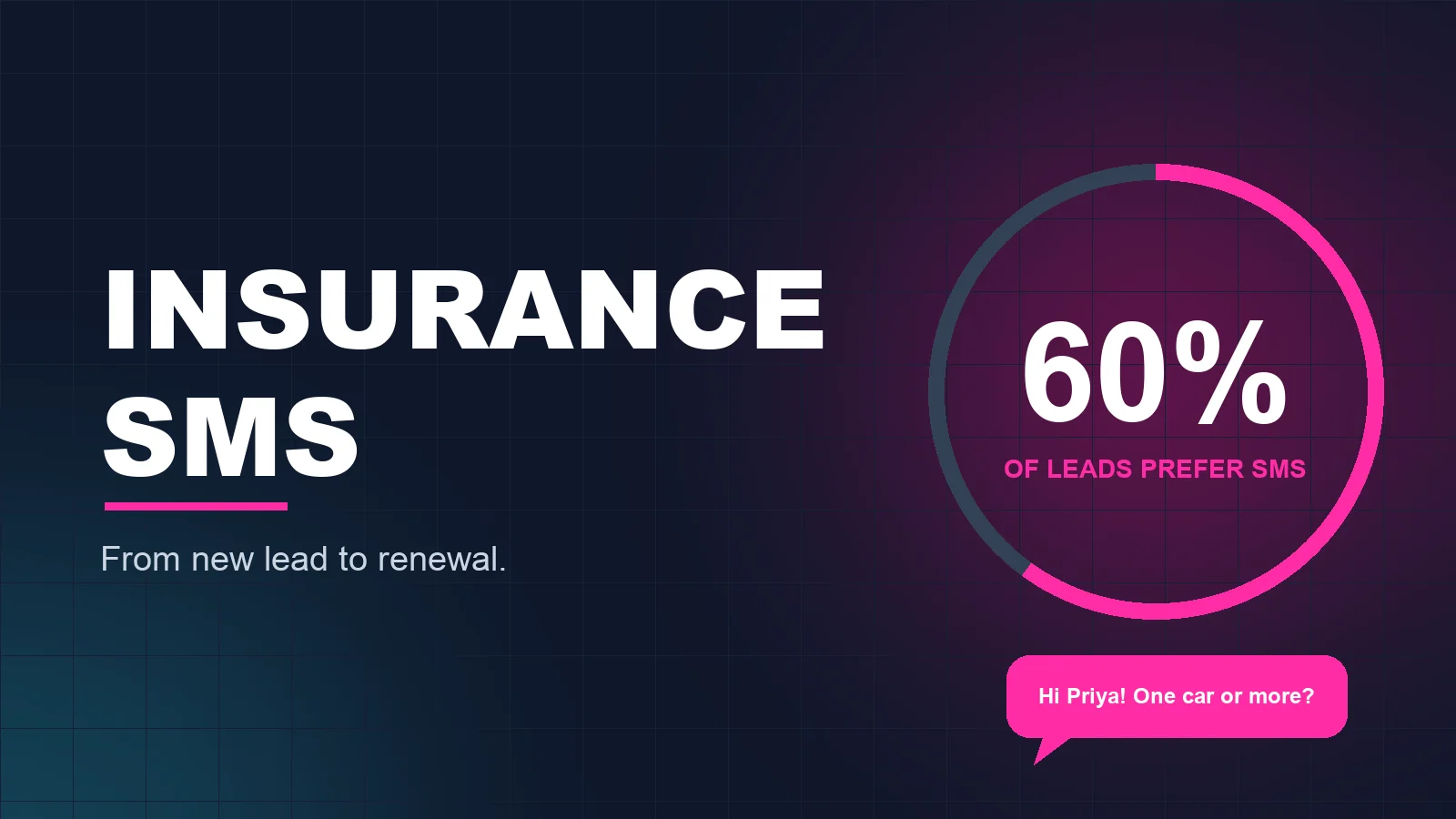
- Buyers prefer it. 60% of leads want the first contact by SMS.
- Insurance is a follow-up business. 80% of sales need five or more touches. Text makes persistence polite instead of pushy.
- The relationship lasts years. Payments, documents, renewals, and reviews are all short messages that fit a text.
Manual, Scheduled, or Automated: Choosing Your Texting Setup
| Manual texting | Blasts & scheduled drips | Automated two-way (AI) SMS | |
|---|---|---|---|
| Best for | A handful of leads a week | Announcements and reminders | Agencies buying or generating leads at volume |
| First response | When you get to it | Fast but generic | Seconds, personalized |
| Replies | You answer each one | Often go unanswered | Answered and qualified 24/7 |
| Follow-up | Depends on memory | Fixed sequence, ignores replies | 5+ touches that adapt and stop on reply |
| Your time | Spent typing | Spent calling cold | Spent with ready buyers |
Most growing agencies outgrow manual texting quickly and find that blasts create replies nobody answers. Automated two-way SMS is the setup that scales.
The Insurance SMS Playbook: 7 Stages
Stage 1: New-lead response
Text within seconds of the quote request. Use your name, your agency, the type of coverage they asked about, and one simple question. Responding in under five minutes brings up to a 9× higher contact rate, and on shared leads, seconds decide who gets the conversation.
Stage 2: Quote follow-up
Most quotes do not bind on the first conversation. Follow up with a helpful angle each time: a question about coverage needs, a reminder that the quote is ready, an offer to review it by phone. When the prospect is ready to talk, connect them right away with a live call transfer or book a time.
Stage 3: Aged and dormant leads
Old leads are not dead leads. Rates change, policies come up for renewal, and life events happen. A low-pressure text to opted-in aged leads ("Still shopping for auto coverage, or all set?") reopens conversations at almost no cost. We cover this in depth in How to Convert Aged Leads at Scale.
Stage 4: Appointments and no-shows
Confirm the appointment when it is booked, remind the day before and an hour before, and make rescheduling a one-word reply. See SMS Appointment Reminders for templates and timing.
Stage 5: Payments, documents, and service
Use texts for payment reminders, missing-document nudges, ID card delivery, and claims check-ins. Send links to your secure portal instead of asking for sensitive details by text.
Stage 6: Renewals and retention
Start early. A text well before the renewal date, offering a quick coverage review, keeps clients from shopping quietly. A second reminder closer to the date and a thank-you after renewal close the loop.
Stage 7: Cross-sell and reviews
After a positive moment (a smooth claim, a renewal, a saved premium) ask for a review or a referral, or mention a relevant second line such as bundling home and auto. Keep it relevant and occasional.
Texting by Line of Business
The seven stages apply everywhere, but each line has its own rhythm:
Auto
Fast, price-driven, and heavily shopped. Speed matters most here. Ask about the number of vehicles and drivers and the current renewal date, then get to the quote quickly.
Home
Often tied to a closing date or a renewal. Ask whether they are buying, refinancing, or shopping an existing policy. Bundling with auto is the natural cross-sell.
Commercial
Longer cycles and more questions. Use text to book a discovery call and to chase the documents needed for a quote, such as loss runs and current declarations, through a secure link.
Health and Medicare
These lines carry extra marketing rules. Keep texts to scheduling and service, never discuss health details by text, and follow line-specific requirements.
A Sample First-Week Cadence for a New Insurance Lead
| Touch | When | Channel | Purpose |
|---|---|---|---|
| 1 | Seconds after the quote request | SMS | Introduce yourself, ask one qualifying question |
| 2 | A few hours later, if no reply | SMS | Short nudge: "Still comparing coverage?" |
| 3 | Day 1–2 | Call, then voicemail + text | Try for a live conversation |
| 4 | Day 3–4 | SMS | Quote is ready, offer to walk through it |
| 5 | Day 5–7 | SMS with booking link | Make the review call one tap away |
| 6+ | Monthly, and before their renewal date | SMS | Stay in touch until they reply, book, or opt out |
Stop the sequence as soon as the lead replies, books, or opts out. More on cadence design in How to Improve Lead Follow-Up Time.
Insurance Text Message Templates
Swap in your details. Keep the first message short and always include an opt-out.
1. New-lead response
"Hi Priya, it's Sam from [Agency] about the auto quote you requested. Is this for one car or more? Reply STOP to opt out."
2. Qualifying question
"Thanks! Are you currently insured, and when does your policy renew? That helps me find your best options."
3. Quote ready
"Hi Priya, your quote is ready. Want me to walk you through it on a quick call now, or would later today work better?"
4. No-reply nudge
"Hi Priya, Sam from [Agency] again. Still comparing auto coverage? Happy to answer questions here by text."
5. Aged-lead re-engagement
"Hi Priya, Sam at [Agency]. You looked at auto coverage with us a while back. Still shopping, or are you all set? Reply STOP to opt out."
6. Appointment reminder
"Reminder: your coverage review with Sam is tomorrow at 10:00 AM. Reply C to confirm or R to reschedule."
7. Payment or document reminder
"Hi Priya, a friendly reminder that your payment is due on [date]. You can pay securely here: [link]. Questions? Reply to this text."
8. Renewal notice
"Hi Priya, your auto policy renews on [date]. Want a quick review to make sure you still have the best rate and coverage? I can call or text the options."
9. Review request
"Glad we could help with your claim, Priya. If you have a minute, a quick review means a lot to our small team: [link]. Thank you!"
Staying Compliant: TCPA, 10DLC, and Lead-Buyer Rules
Consent
Marketing texts require prior express written consent under the TCPA. If you generate your own leads, put clear consent language on your forms. If you buy leads, ask the vendor exactly how consent was captured and keep the records. Consent rules for purchased leads have been changing, so review them with your compliance contact regularly.
Opt-outs, quiet hours, and 10DLC
- Opt-outs: honor STOP and any other reasonable opt-out request right away.
- Quiet hours: text at reasonable local times; some states set stricter windows than the federal rules.
- 10DLC: register your agency and campaigns with the carriers, or your messages may be filtered.
- Identify yourself: name and agency in the first message.
Health and sensitive information
For health, life, and Medicare lines, keep health details out of text messages, and follow any line-specific marketing rules. See SMS Marketing for Medicare Agents and Life Insurance SMS Marketing for those lines.
This is general guidance, not legal advice. Our SMS & voice compliance guide goes deeper.
Mistakes Insurance Agents Make With SMS
- Calling first, texting never. Most calls from unknown numbers are ignored.
- Responding after lunch. On shared leads, minutes are too slow.
- Sending blasts and ignoring the replies.
- Giving up after two attempts when most sales need five or more.
- Only texting to sell. Service and renewal texts build the trust that makes cross-sell work.
- Buying leads without checking consent.
Measuring What Matters
- Time to first touch
- Contact rate: leads you actually have a conversation with
- Quotes and booked calls per 100 leads
- Cost per appointment and cost per bound policy
- Aged-lead recovery: conversations reopened from old leads
- Renewal retention rate
- Opt-out rate
How to Get Started in 30 Days
- Week 1: Consent and registration. Update form consent language, confirm how your lead vendors capture consent, and register for 10DLC.
- Week 2: Instant first response. Automate a personal text to every new lead and track time to first touch.
- Week 3: Follow-up and booking. Turn on the first-week cadence and connect your calendar or live call routing.
- Week 4: Lifecycle messages. Add appointment reminders, renewal notices, and a simple aged-lead re-engagement campaign. Review contact rate and opt-outs weekly.
How Conversta Works for Insurance Agents
Conversta texts every new insurance lead within seconds, holds a natural two-way conversation, and qualifies them: what coverage, how many vehicles or drivers, when the current policy renews. Ready prospects are booked on your calendar or bridged to you on a live call. Everyone else is nurtured automatically for weeks or months, with opt-outs handled for you.
Agencies using Conversta see up to a 9× contact rate, 2.4× more appointments, and as much as 40% lower cost per appointment. Setup takes under 10 minutes.
Frequently Asked Questions
Is it legal for insurance agents to text leads and clients?
Yes, with proper consent. Marketing texts require prior express written consent under the TCPA. Register for 10DLC, identify your agency, and honor opt-outs immediately.
What should an insurance agent text a new lead?
Your name, your agency, the coverage they asked about, and one easy question, plus an opt-out. For example: "Hi Priya, it's Sam from [Agency] about your auto quote. Is this for one car or more?"
When is the best time to text insurance leads?
Immediately after they request a quote, when intent is highest. For follow-ups, text during reasonable local hours and avoid late evenings and early mornings.
Can insurance agents automate their texting?
Yes. Automated two-way SMS responds to new leads in seconds, answers questions, qualifies, and books calls. Agents step in when the prospect is ready to talk.
How many times should I follow up on an insurance lead?
At least five. 80% of sales need five or more follow-ups, and most agents stop after two. Continue until the lead replies, books, or opts out.
Final Thoughts
Insurance is won by the agent who shows up first and stays in touch longest. Texting lets you do both without living on the phone. Start with the first response, add follow-up and renewals, and let automation carry the routine messages so your time goes to the conversations that bind policies.
See it work on your own leads. Start your live demo — no credit card, setup in under 10 minutes.