Speed to Lead
Speed to Lead: Why It Matters and How to Improve It (2026 Guide)
Speed to Lead: Why It Matters and How to Improve It (2026 Guide)
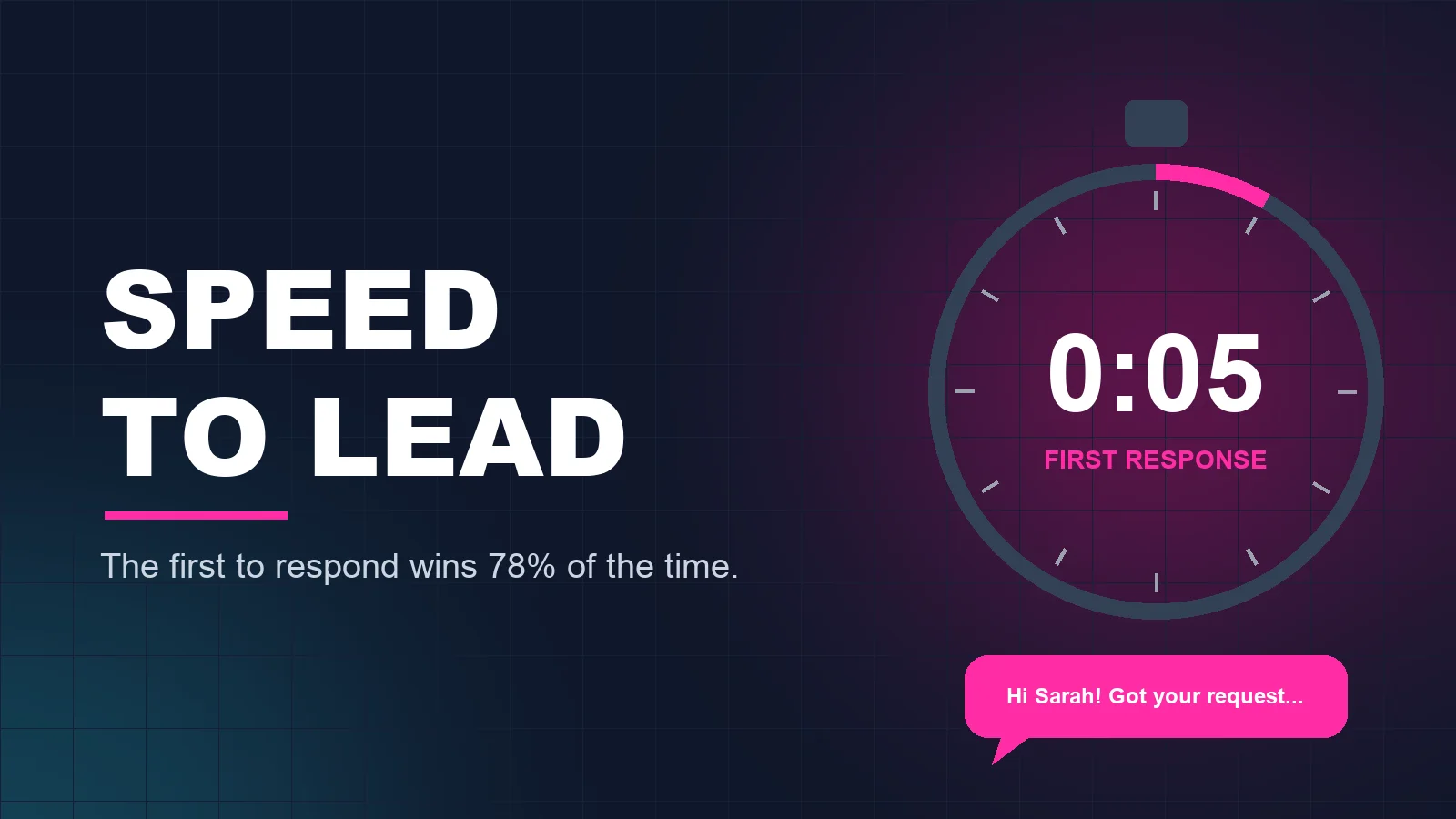
The first business to respond to a lead wins the deal 78% of the time. Not the cheapest one. Not the one with the best reviews. The fastest one.
Yet most sales teams still take hours, sometimes days, to reach a new inbound lead. By then the prospect has filled out three more forms, heard from a competitor, and moved on. The gap between "form submitted" and "first real conversation" is your speed to lead, and for most teams it is the most expensive number they never track.
This guide covers what speed to lead is, what a good lead response time looks like in 2026, what slows teams down, and ten practical ways to close the gap, so every lead you pay for actually gets a conversation.
What Is Speed to Lead?
Speed to lead is the time between the moment a prospect raises their hand (submits a form, clicks a call ad, texts your number, requests a quote) and the moment they receive their first meaningful response from your business.
The formula is simple: Speed to lead = time of first meaningful contact − time the lead was created.
Two words in that definition carry the weight. Meaningful means a response the lead can actually engage with: a personal text that references what they asked for, a live call from someone who can help, or a scheduling link that books a real appointment. An automated "Thanks, we received your submission" email does not count. It confirms the form worked. It does not start a conversation.
First matters too. Speed to lead measures the opening move, not total follow-up effort. A team that calls twelve times over two weeks but starts on day two has usually already lost. Persistence matters (more on that below), but it only pays off when the first touch lands while intent is still hot.
You will also hear the term lead response time. The two are often used interchangeably. The practical difference: lead response time is the metric; speed to lead is the operating discipline built around shrinking it.
Why Speed to Lead Matters
Every inbound lead is a moment of peak intent. Someone stopped what they were doing to ask about a mortgage rate, an insurance quote, or a roofing estimate. That intent starts decaying the second they hit submit.
The first responder wins
The first business to respond wins 78% of the time. Buyers comparing options rarely wait for the fifth-fastest company to call back. Whoever answers first sets the frame for the whole decision: the price anchor, the process, and the relationship.
Intent decays by the minute
Teams that respond in under five minutes see up to a 9× higher contact rate. After that window, attention moves on, to the inbox, the job, the kids, or your competitor's follow-up. A lead who would have replied instantly at minute two often never replies at hour two.
You are paying for leads you never talk to
For teams that buy leads or run paid ads, slow response is a budget problem disguised as a sales problem. Every lead you fail to reach is ad spend with zero return. If your contact rate is low, you probably do not need more leads. You need to reach the ones you already paid for. (We break down the real math in The Hidden Cost of the Leads You Never Talk To.)
Your reps' time is finite
Slow, manual follow-up pushes reps into chase mode. Top reps can burn 10–15 hours a week chasing prospects who were never going to pick up a call from an unknown number. That is time not spent closing.
What Is a Good Lead Response Time?
The short answer: under five minutes is the standard worth holding yourself to, and seconds is the standard that wins.
Under five minutes is where the 9× contact-rate advantage lives. But in 2026, buyers routinely submit their details to several companies at once, so five minutes is table stakes. The teams winning in competitive verticals like mortgage, insurance, and direct lending respond in seconds, because the competitor they are racing is also trying to hit five minutes.
| Response window | What the lead experiences | Verdict |
|---|---|---|
| Within seconds | A relevant text arrives while they are still on their phone, often before they close the tab | Best. You are first, and the conversation starts at peak intent |
| Under 5 minutes | Still engaged and likely to reply | Strong. The 9× contact-rate window |
| 5–60 minutes | Attention has moved on; they may have heard from a competitor | Risky. Contact odds drop fast |
| Same day (hours) | Often already talking to someone else | Weak. You are competing for second place |
| Next day or later | The request feels like old news | Recovery mode. Needs nurture, not speed |
One caution: a fast response that says nothing does not count. A seconds-fast text that reads "A rep will contact you soon" is just a slow response in disguise. The goal is a first touch that is fast and meaningful: it answers a question, qualifies, or books.
What Slows Down Speed to Lead?
Slow response is rarely laziness. It is process friction nobody designed out. The usual culprits:
- Manual lead assignment. Leads sit in a shared inbox or CRM queue until someone claims them.
- Round-robin routing that ignores availability. The lead goes to a rep who is on a call, at lunch, or off shift.
- After-hours and weekend gaps. Consumer leads arrive evenings and weekends, when nobody is working.
- Call-first playbooks. Only 19% of people answer calls from unknown numbers, so the first "response" is usually an unanswered ring and a voicemail.
- Too many handoffs. Marketing to SDR to closer to scheduler, with a delay at every step.
- Disconnected tools. The form, CRM, dialer, and calendar do not talk to each other.
- Volume spikes. A campaign goes live and reps cannot keep up with the queue.
- Quitting too early. 80% of sales need five or more follow-ups, but most reps stop after two.
- No measurement. Teams that do not track response time assume it is fine.
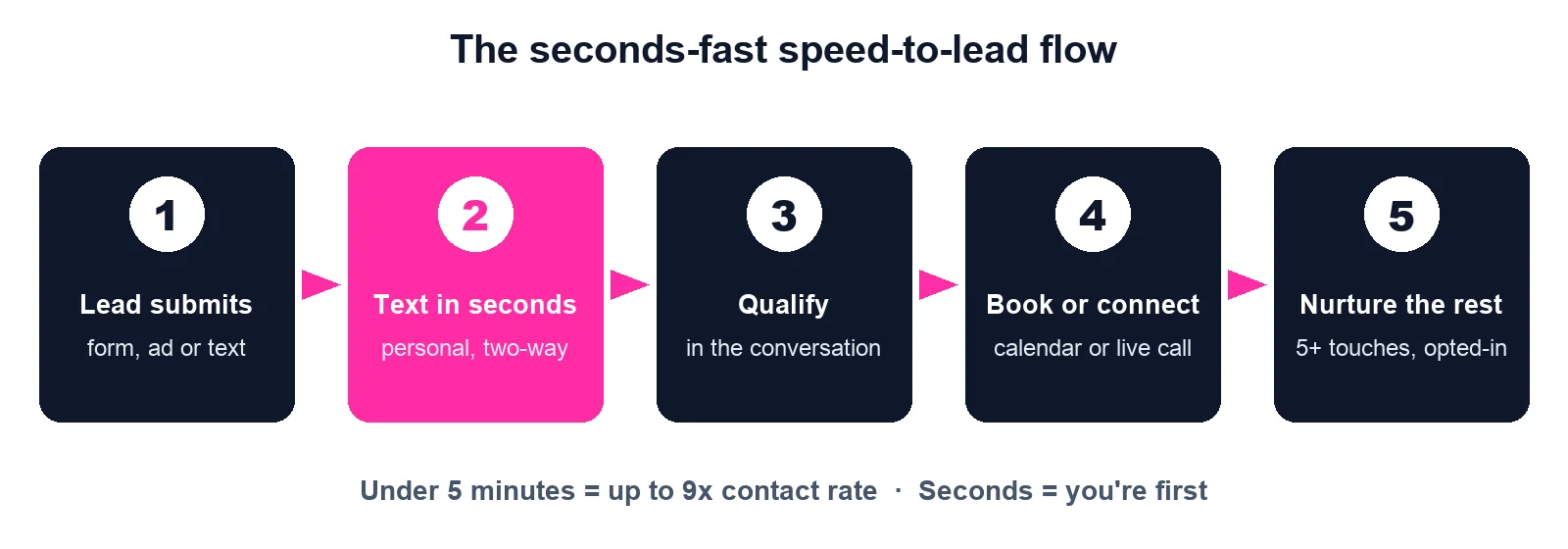
How to Improve Speed to Lead: 10 Proven Steps
Here is the playbook, in the order most teams should tackle it.
1. Measure your current response time
You cannot fix what you do not measure. Pull lead-created and first-meaningful-contact timestamps from your CRM for the last 30 to 90 days. Look at the median, not just the average, because a few instant responses can hide a lot of day-long delays. Then break it down by lead source, hour of day, and day of week. Most teams discover their after-hours response time is measured in hours, or never.
2. Remove friction from forms and landing pages
Speed to lead starts before the lead exists. Keep forms short: name, phone, and the one or two qualifying fields that matter. Capture clear consent to text on the form, and tell the prospect they will get a text right away. Add click-to-text and click-to-call options for people who would rather start the conversation themselves.
3. Automate the first meaningful response
This is the biggest lever you have. No human team can respond in seconds, 24/7, across every lead source. Software can. The first touch should fire the instant a lead is created, personalized with their name and what they asked about, and written to start a conversation rather than just acknowledge receipt.
4. Lead with SMS, not the dialer
60% of leads prefer to be engaged by text first, and only 19% answer unknown numbers. Leading with a call means most of your fast responses land in voicemail. Leading with a text means the lead replies when they can, often within minutes, and the call happens once they are ready for it. (More on this in Is Cold Calling Dead? Why Only 19% Answer Unknown Numbers.)
5. Qualify inside the conversation
Do not make a rep burn a call to find out a lead is not a fit. A two-way text conversation can confirm the basics (timeline, budget, location, the product they need) before a human gets involved. Qualified leads move forward. Everyone else goes into nurture. See How AI Qualifies Leads for the full framework.
6. Route by readiness, not rotation
Round-robin is fair to reps but slow for leads. Route based on who is available right now and which leads are ready to talk right now. A hot lead should never wait in a queue behind a cold one.
7. Make booking instant
When a lead is ready, send a personalized scheduling link that shows real availability. No email back-and-forth, no "what time works for you?" loops. Confirmed appointments land directly on the rep's calendar.
8. Bridge hot leads to a live call
Some leads are ready right now. When a prospect texts "can someone call me?", the best answer is a live call within seconds, bridging the lead straight to an available rep while interest peaks. Our guide to live call transfer covers how to hand off without losing the lead.
9. Follow up five or more times across channels
Speed wins the first touch. Persistence wins the rest. With 80% of sales needing five or more follow-ups, build an automated sequence across SMS, voicemail, and callbacks that keeps going after a human would have quit, and stops the moment the lead replies, books, or opts out. Every touch should respect consent, quiet hours, and opt-out requests (see our SMS & voice compliance guide). For the full cadence, read How to Improve Lead Follow-Up Time Without Hiring More Reps.
10. Monitor lag points and drop-offs
Once the system is live, review it weekly. Where do leads stall: first reply, qualification, booking, or show-up? Which sources convert and which do not? Speed to lead is not a one-time project. It is a metric you manage like revenue.
Manual Follow-Up vs. Automated Speed to Lead
Most teams already know speed matters. The real question is whether their process can deliver it. Here is how a rep-driven model compares with automated engagement.
| Factor | Manual (rep-driven) | Automated (AI-driven) |
|---|---|---|
| First response time | Minutes to hours, depending on who is free | Seconds, every time |
| After hours & weekends | Leads wait until the next shift | Covered 24/7 |
| First channel | Usually a phone call (only 19% answer unknown numbers) | SMS first, the channel 60% of leads prefer |
| Follow-up persistence | Most reps stop after 2 attempts | 5+ touches until the lead responds or opts out |
| Qualification | A rep spends a call finding out | Handled in the conversation before handoff |
| Handling volume spikes | Needs more headcount | Absorbs spikes without new hires |
| Where rep time goes | Chasing unresponsive leads | Talking only to ready-to-buy leads |
For most teams the right answer is both. Automation handles the first touch, qualification, and persistence. Humans handle the conversations that close.
Business Benefits of Faster Speed to Lead
More contacts from the same lead spend
Responding in seconds instead of hours is how teams reach up to a 9× higher contact rate without buying a single extra lead. One direct-lending team moved its contact rate from 12% to 65%.
More appointments on the calendar
When the lead gets an answer and a booking link while intent is high, more of them book. Teams using automated engagement see up to 2.4× more appointments.
Lower cost per appointment
Same ad budget, more conversations, more booked calls. That is how cost per appointment falls, by as much as 40% for some teams.
Reps who close instead of chase
When software handles first touch and follow-up, reps spend their time on qualified, ready-to-talk leads. That is what 100% sales efficiency looks like in practice.
A better buyer experience
Fast, relevant replies on the channel buyers prefer feel like good service, not pressure. The buyer asked a question. You answered it right away.
Speed to Lead by Industry
The principle is universal, but the pressure points differ by vertical:
- Mortgage. Rate shoppers submit to several lenders at once, and the first loan officer with a real answer usually gets the application. See SMS Marketing for Mortgage Lenders.
- Insurance. Quote requests go cold fast, and shared leads mean you are racing other agents from the first second. See SMS Marketing for Insurance Agents.
- Direct lending. Teams that buy leads live or die by contact rate. Slow response is wasted spend.
- Home services. Homeowners book the first contractor who can give them an estimate time.
- Medicare. Senior leads need fast, respectful, compliance-first engagement, especially around enrollment periods.
- Political & fundraising. Donor and volunteer interest spikes around moments. Instant response captures it before it fades.
- BDCs and contact centers. Connect rates improve when the first touch is a text, not a dial. See How to Improve Contact Center & BDC Connect Rates.
How Conversta Improves Speed to Lead
Conversta was built around one idea: the first business to respond wins. Here is how it closes the gap between interest and conversation:
- Instant lead response. The moment a form is submitted, Conversta sends a personalized text within seconds, day or night.
- Real two-way conversation. Human-like AI replies answer questions and qualify the lead 24/7.
- Automated scheduling. Ready leads get a personalized booking link, and confirmed appointments land on your calendar.
- Live call connection. Hot leads are bridged straight to an available rep while interest peaks.
- Multichannel follow-up. Missed calls trigger voicemail, callback, and reschedule flows, so no lead goes dark.
- Long-term nurturing. Leads who are not ready yet are nurtured automatically for weeks or months.
Teams using Conversta see up to a 9× contact rate, 2.4× more appointments, and as much as 40% lower cost per appointment. As one direct-lending founder put it, Conversta "finds the needle in the haystack automatically." Setup takes under 10 minutes, and all outreach runs to opted-in leads with consent and opt-out handling built in.
Frequently Asked Questions
What is speed to lead?
Speed to lead is the time between a prospect submitting their information and receiving their first meaningful response from your business. The shorter it is, the more likely you are to reach the lead and win the deal.
What is a good speed to lead benchmark?
Under five minutes is the minimum standard, and it is where teams see up to a 9× higher contact rate. In competitive verticals, the winning benchmark is seconds, which in practice requires automation.
How do you calculate speed to lead?
Subtract the time the lead was created from the time of the first meaningful contact. Track the median across all leads, and break it down by source, hour, and day to find where delays hide.
Should the first response be a call or a text?
For most inbound leads, a text. Only 19% of people answer calls from unknown numbers, while 60% prefer to be engaged by SMS first. Text first, then call once the lead is ready to talk.
Will a fast response annoy leads?
Not when it is relevant and consented. The lead just asked for information. A quick, personal reply that answers their question feels like good service. What annoys leads is irrelevant blasting, ignored opt-outs, and messages at odd hours.
Can AI really respond to leads in seconds?
Yes. AI lead engagement tools like Conversta trigger a personalized text the instant a lead is created, hold a two-way conversation, and hand qualified leads to a rep by booking link or live call.
Final Thoughts
Speed to lead is not a nice-to-have metric. It decides which company gets the conversation, and the conversation decides who gets the deal. The fix is not asking reps to work faster. It is building a system that responds in seconds, leads with the channel buyers prefer, keeps following up after humans would quit, and puts only ready-to-buy leads in front of your team.
Start by measuring your real response time this week. If the number surprises you, you already know where your next deals are hiding.
See it work on your own leads. Start your live demo — no credit card, setup in under 10 minutes.